Häufig gestellte Fragen & Antworten rund um Spastik
Spastik
Bei einer Spastik handelt es sich um eine krankhafte, chronische Erhöhung der Muskelspannung, die durch eine Schädigung des zentralen Nervensystems (ZNS) hervorgerufen wird. Erfahren Sie hier die wichtigsten Infos zur Spastik.
Eine Spastik (auch Spastizität) ist eine chronische, unwillkürliche Steigerung der Muskelspannung (Muskeltonus), die durch eine gestörte Kommunikation zwischen dem zentralen Nervensystem (Gehirn, Hirnstamm oder Rückenmark) und der Muskulatur verursacht wird.
Im gesunden Zustand reguliert das Nervensystem Bewegungen über ein präzises Gleichgewicht aus aktivierenden und hemmenden Signalen. Ist dieser Austausch aufgrund einer Verletzung oder Erkrankung gestört, geraten die Muskeleigenreflexe außer Kontrolle. Die Folge ist eine dauerhafte, unkontrollierbare Anspannung der betroffenen Muskeln.
Ein charakteristisches Merkmal der Spastik ist ihre Geschwindigkeitsabhängigkeit: Der Widerstand im Muskel nimmt massiv zu, je schneller er passiv gedehnt wird. Dieser häufig oder dauerhaft erhöhte Muskeltonus führt zu Muskelsteifigkeit und damit zu einer Einschränkung der Beweglichkeit. Zudem können schmerzhafte Fehlhaltungen entstehen, die Alltagsaktivitäten und die allgemeine Lebensqualität beeinträchtigen.
Mehr Informationen zu den Hintergründen finden Sie unter: https://www.spastikinfo.de/spastik-was-ist-das/
Eine Spastik entsteht infolge von Schädigungen im Zentralnervensystem (ZNS), also im Gehirn oder im Rückenmark. Sie tritt oft zeitversetzt – Wochen oder Monate nach der eigentlichen Verletzung – auf.
Häufige Ursachen für ZNS-Schädigungen:
- Schlaganfall
- Multiple Sklerose (MS)
- Schädel-Hirn-Trauma oder Rückenmarksverletzungen
- Frühkindliche Hirnschädigungen (Zerebralparesen)
- Entzündungen oder Tumoren im Gehirn
Eine frühzeitige Behandlung ist essenziell, um irreversible Versteifungen von Muskeln und Gelenken (Kontrakturen) zu verhindern.
Ein erhöhter Muskeltonus wird von Betroffenen meist als permanente Steifigkeit, einem ausgeprägten Spannungsgefühl oder als unnachgiebiger Widerstand in den Gliedmaßen wahrgenommen. Viele Patient*innen beschreiben die Empfindung als ein Gefühl des „Eingesperrtseins“ in der eigenen Muskulatur, oft begleitet von einer subjektiven Schwere der betroffenen Gliedmaßen.
Typische Empfindungen bei erhöhtem Tonus:
- Permanente Spannung: Ein Gefühl, als stünde der Muskel unter Dauerdruck (ähnlich einem massiven Muskelkater).
- Widerstand: Eigenbewegungen fühlen sich mühsam an, als müsse man gegen ein elastisches Band anarbeiten.
- Schmerzhafte Krämpfe: Die gesteigerte Spannung kann in schmerzhafte Einschüsse oder Spasmen übergehen.
Klinisch äußert sich ein erhöhter Muskeltonus durch einen gesteigerten Widerstand bei passiven Bewegungen, sichtbare Fehlhaltungen sowie unwillkürliche Muskelaktivitäten. Das markanteste äußere Zeichen ist die Geschwindigkeitsabhängigkeit: Je schneller ein Gelenk bewegt werden soll, desto stärker verhärtet sich die Muskulatur als Reaktion darauf.
Objektive Manifestationen:
Bewegungseinschränkung: Gelenke lassen sich nicht mehr im vollen Umfang beugen oder strecken.
Spastische Fehlstellungen: Typische Haltungsmuster wie die zur Faust geballte Hand, der angewinkelte Arm oder der Spitzfuß.
Klonus und Spasmen: Rhythmisches Zucken (Klonus) oder plötzliche, einschießende Muskelzuckungen (Spasmen).
Veränderte Reflexe: Gesteigerte Muskeleigenreflexe (Hyperreflexie), die bereits auf minimale Reize reagieren.
Die Behandlung einer Spastik erfordert in der Regel eine Kombination verschiedener Therapieverfahren (multimodale Therapie). Sie sollte stets zielorientiert sein und nicht allein auf die Reduktion der Spastik abzielen, um die individuelle Beweglichkeit und Lebensqualität zu verbessern. Jede Therapiemaßnahme muss grundsätzlich im Vorfeld mit den behandelnden Ärzt*innen (z. B. Neurolog*innen) abgeklärt und individuell abgestimmt werden.
Die wichtigsten Therapiesäulen:
- Physiotherapie: Bildet die Basis jeder Behandlung, um die motorischen Funktionen zu verbessern oder wiederherzustellen und strukturellen Verkürzungen vorzubeugen.
- Botulinumtoxin Typ A: Empfohlen bei fokaler, multifokaler und segmentaler Spastik.
- Oral angewendete Medikamente: Einsatz von Antispastika zur systemischen Senkung der Spannung bei multisegmentaler und generalisierter Spastik.
- Operative Verfahren: Zum Beispiel die intrathekale Baclofen-Therapie (ITB) bei schwerer multisegmentaler bzw. generalisierter Spastik, welche nicht anderweitig adäquat behandelbar ist.
Mehr Informationen zu den verschiedenen Therapien finden Sie unter: Spastik-Behandlung
Orale Medikamente wie Baclofen, Tizanidin oder Diazepam wirken zentral auf das Gehirn und Rückenmark. Sie dämpfen dort die Nervensignale, wodurch sich die Muskeln systemisch entspannen und Verkrampfungen sowie eine erhöhte Muskelspannung nachlassen. Da diese Wirkstoffe über den Verdauungstrakt aufgenommen werden, verteilt sich ihre Wirkung im gesamten Körper.
Wichtige Hinweise zur Anwendung:
- Wirkung: Nicht lokal begrenzt, wirkt auf den gesamten Körper.
- Risiko: Kann bereits bestehende Lähmungserscheinungen ungünstig verstärken.
- Nebenwirkungen: Eine ärztliche Aufklärung und die Beachtung der Packungsbeilage sind zwingend erforderlich.
Die intrathekale Baclofen-Therapie (ITB) entspannt die gesamte Körpermuskulatur durch die direkte Gabe des Wirkstoffs Baclofen über eine implantierte Pumpe in den Liquorraum am Rückenmark. Diese Behandlung hilft vor allem Menschen mit ausgeprägter Muskelsteifheit oder unwillkürlichen Bewegungen, die mehrere Körperregionen betreffen – unabhängig davon, ob die Ursache im Rückenmark oder im Gehirn liegt.
Technische Umsetzung:
- Eine Pumpe wird operativ unter die Bauchhaut implantiert.
- Baclofen wird über einen Katheter, der mit dem Rückenmark der Lendenwirkbelsäule verbunden ist, eingeführt.
- Die Lage des Katheters kann, je nach Behandlungsziel, bis in den Brust- oder Halsbereich reichen.
Da das Baclofen direkt an den Wirkort gelangt und nicht erst über das Blut ins Gehirn transportiert werden muss, sind deutlich geringere Mengen ausreichend, um die Muskulatur zu entspannen.
- Dies ermöglicht eine hohe Wirksamkeit bei deutlich geringeren Wirkstoffmengen und Nebenwirkungen im Vergleich zur oralen Einnahme.
Physio- und Ergotherapie zielen darauf ab, die funktionelle Beweglichkeit im Alltag trotz der Erkrankung zu erhalten oder wiederherzustellen.
Physiotherapie: Ist die Basis jeder Spastikbehandlung und individuell auf Patient*innen zugeschnitten. Sie nutzt regelmäßige Dehnungsübungen zur Reduktion von Muskelspannung und -steifigkeit und kräftigt gezielt betroffene Muskeln und Gelenke, um die Beweglichkeit zu erhalten.
Ergotherapie: Sie trainiert Alltagstätigkeiten (z. B. Anziehen, Essen) und schult den Umgang mit speziellen Hilfsmitteln zur Steigerung der Selbstständigkeit.
Funktion des Muskels
Die Hauptfunktion des Muskels ist es sich zusammenzuziehen (Kontraktion) und zu lockern (Entspannung), um somit den Körper zu bewegen und zu stabilisieren.
Die Steuerung der Skelettmuskulatur erfolgt über elektrische Impulse des Nervensystems, die an der motorischen Endplatte in chemische Signale umgewandelt werden. Der versorgende Nerv schüttet dabei den Botenstoff Acetylcholin aus. Dieser Prozess bewirkt im Muskel die Umwandlung von chemischer in mechanische Energie, wodurch die Kontraktion ausgelöst wird.
Eine Muskelkontraktion ist das aktive Zusammenziehen eines Muskels als Reaktion auf einen spezifischen Nervenimpuls. Da Muskeln sich nur aktiv verkürzen können, basieren Bewegungen auf dem Zusammenspiel von Agonist (Spieler) und Antagonist (Gegenspieler). Damit eine kontrollierte Bewegung entsteht, muss der Gegenspieler während der Kontraktion des Spielers passiv gedehnt werden.
Nerven fungieren als Signalgeber, die dem Muskel Informationen über die Intensität und Dauer der Anspannung übermitteln. Diese Signale stammen entweder aus dem Gehirn über absteigende Bahnen oder werden über Reflexbögen im Rückenmark gesteuert. Störungen dieser Nervenfunktion führen unmittelbar zu abnormaler Muskelaktivität. Medikamente wie Botulinumtoxin, das bei Erkrankungen wie Spastik eingesetzt werden kann, greifen in dieses Zusammenspiel von Nerven und Muskeln ein. Wenn die Ausschüttung des Botenstoffs Acetylcholin durch Botulinumtoxin unterbunden wird, kommt es zu einer Verringerung der Muskelspannung, bis sich die neuromuskuläre Übertragung wieder regeneriert.
Botulinumtoxin
Botulinumtoxin ist ein hochwirksames biologisches Protein (Neurotoxin), das in der Medizin zur gezielten Entspannung überaktiver Muskulatur eingesetzt wird. Der Wirkstoff wird unter kontrollierten Bedingungen aus Kulturen des Bakteriums Clostridium botulinum gewonnen und pharmazeutisch für die lokale Anwendung aufbereitet.
In der neurologischen Therapie reichen bereits sehr geringe Mengen aus, um pathologische Muskelverkrampfungen effektiv zu reduzieren. Während die Substanz historisch vor allem im Kontext von Lebensmittelvergiftungen (Botulismus) bekannt war, konnte es durch moderne Aufbereitung und Dosiskontrolle zu einem vielseitigen therapeutischen Wirkstoff entwickelt werden.
Botulinumtoxin gehört zu den potentesten bekannten Neurotoxinen und kann bei systemischer Exposition (z. B. kontaminierte Nahrung) Botulismus mit einer Lähmung des gesamten Körpers und der Atemwege auslösen. In der zugelassenen medizinischen Anwendung gilt es jedoch als wirksam und sicher, da es hochgereinigt, sehr niedrig dosiert und lokal begrenzt injiziert wird. Die therapeutische Sicherheit basiert auf der direkten Injektion in den Zielmuskel, wodurch eine systemische Verteilung im Blutkreislauf – im Gegensatz zu einer Lebensmittelvergiftung – vermieden werden kann. Die verabreichte Menge wird individuell so berechnet, dass sie die überaktive Muskulatur im gewünschten Maße lokal entspannt.
Der pharmazeutische Wirkstoff Botulinumtoxin Typ A wird in einem aufwendigen biotechnologischen Prozess isoliert, gereinigt und für die medizinische Anwendung standardisiert. Als Ausgangsstoff dienen Proteinkomplexe, die vom Bakterium Clostridium botulinum gebildet werden.
Botulinumtoxin unterbricht die Signalübertragung zwischen Nerv und Muskel, indem es die Ausschüttung des Botenstoffs Acetylcholin an der motorischen Endplatte blockiert. Acetylcholin ist essenziell für die Aktivierung der Muskelfasern; ohne diesen Botenstoff bleibt die Kontraktion aus.
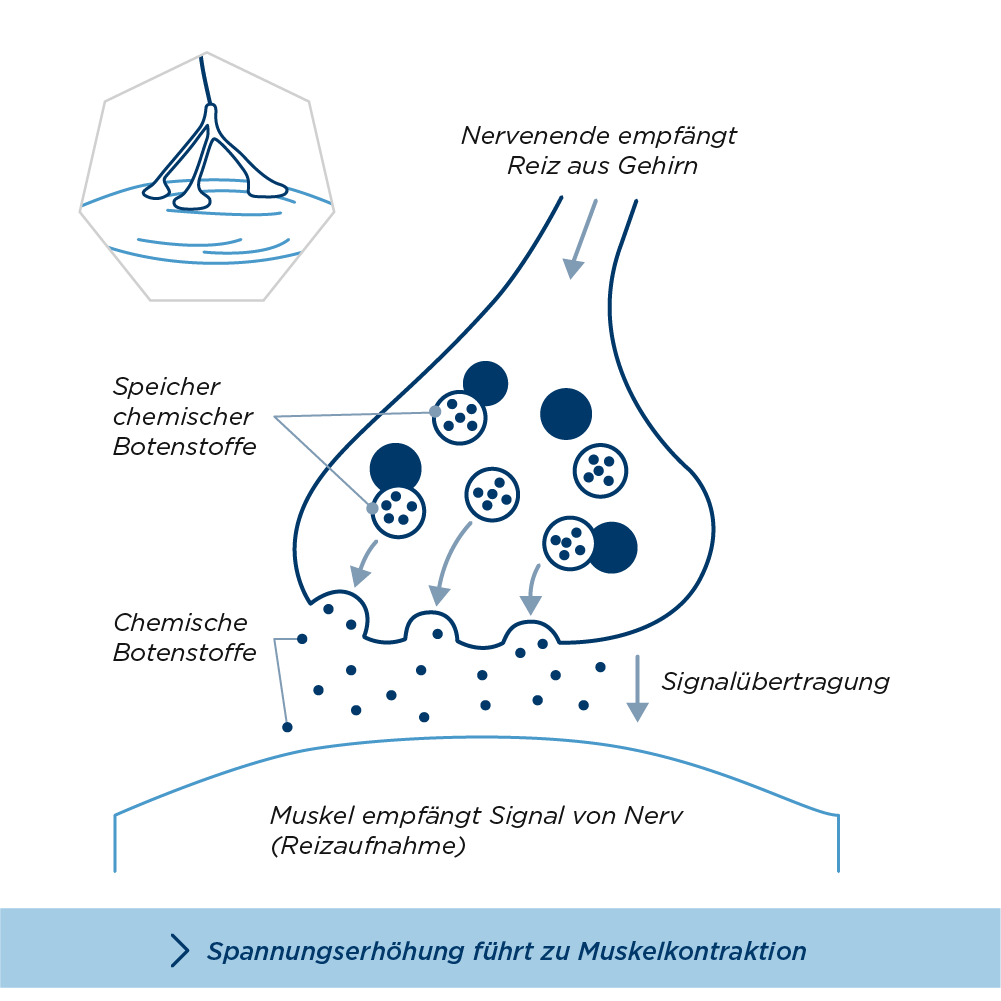
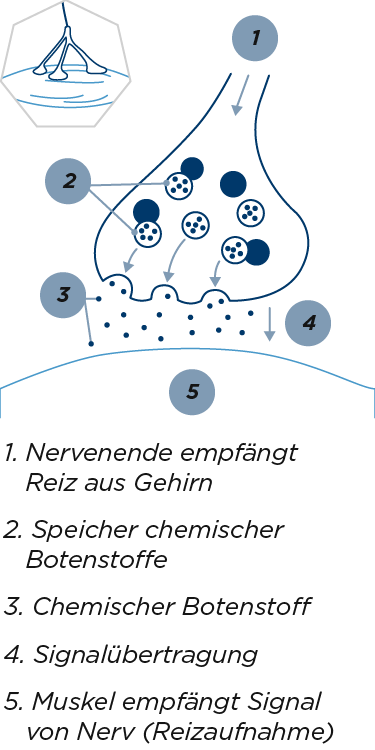
Bei Spastik reduziert die lokale Injektion die krankhaft erhöhte Muskelaktivität und führt dosisabhängig zu einer vorübergehenden Entspannung der betroffenen Muskulatur und zu einer Linderung spastischer Symptome.
Die Wirkung setzt innerhalb weniger Tage nach der Injektion ein, erreicht nach etwa 4 bis 6 Wochen ihr Maximum und hält durchschnittlich 3 bis 4 Monate an. Die Wirkdauer kann individuell variieren und hängt unter anderem von der behandelten Muskelgruppe und der Dosierung ab. Da die Hemmung der neuromuskulären Signalübertragung reversibel ist und der Körper den Wirkstoff kontinuierlich abbaut, ist eine regelmäßige Wiederholung der Behandlung notwendig, um den Therapieerfolg langfristig zu sichern.
Botulinumtoxin Typ A ist für die Behandlung verschiedener neurologischer Krankheitsbilder zugelassen, die durch pathologisch erhöhte Muskelspannungen gekennzeichnet sind.
Zentrale Anwendungsgebiete:
Fokale Spastik: Zum Beispiel nach einem Schlaganfall, einem Schädel-Hirn-Trauma oder bei Multipler Sklerose (MS).
Fokale Dystonien: Wie der Schiefhals (Torticollis spasmodicus) oder der Lidkrampf (Blepharospasmus).
Weitere Indikationen: Chronische Migräne, neurogene überaktive Blase, Hyperhidrose (starkes Schwitzen), Sialorrhoe (unkontrollierter Speichelfluss), Spasmus Hemifacialis (unkontrolliertes Zucken einer Gesichtshälfte) oder andere Zustände mit Muskelüberaktivität.
Eine Behandlung mit Botulinumtoxin darf nicht erfolgen:
- Wenn der Patient unter einer generalisierten Muskelstörung wie Myasthenia gravis leidet.
- Wenn der Patient unter dem Lambert-Eaton Syndrom leidet.
- Bei bekannter Überempfindlichkeit gegen den Wirkstoff oder einen anderen Bestandteil des Arzneimittels.
- Bei einer Infektion.
- Bei einer Entzündung an der vorgesehenen Injektionsstelle.
Die verabreichte Dosis wird individuell an die Bedürfnisse des Patient*innen angepasst. Dabei werden u. a. Schweregrad der Spastik, betroffene Muskelgruppen, Körpergröße und bisherige Behandlungsverfahren berücksichtigt. Ärzt*innen ermitteln in der vorangehenden Untersuchung möglichst präzise den Spannungs- und Funktionszustand der betroffenen Muskulatur, um eine geeignete Dosis festzulegen.
Das Medikament Botulinumtoxin wird mit einer feinen Nadel direkt in die betroffenen Muskeln injiziert. Es blockiert dort vorübergehend die Freisetzung des Botenstoffs Acetylcholin an der neuromuskulären Endplatte. Nach wenigen Tagen setzt die Wirkung ein: Der krankhaft verkrampfte Muskel entspannt sich, spastische Krämpfe und unwillkürliche Bewegungen werden gemindert.
Da die Wirkung von Botulinumtoxin nur wenige Monate anhält, muss die Injektion in regelmäßigen Abständen wiederholt werden. Der Vorteil hierbei ist, dass die Dosis und der Injektionsort bei jeder Behandlung neu angepasst und optimiert werden kann.
Botulinumtoxin ist ein ärztlich verordneter Wirkstoff, der verkrampfte Muskulatur entspannt und bei sachgerechter, lokaler Anwendung in der Regel gut vertragen wird. Wie bei allen Arzneimitteln können auch bei der Anwendung von Botulinumtoxin Nebenwirkungen auftreten, die aber nicht jeden Patient*innen betreffen müssen.
Häufig beschrieben werden vorübergehende lokale Beschwerden wie Schmerzen, Hämatome, Schwellungen oder vorübergehende Muskelschwäche im behandelten Bereich, gelegentlich grippeähnliche Symptome, Müdigkeit oder Hautreaktionen. Schwere systemische Nebenwirkungen (z. B. ausgeprägte Muskelschwäche, Schluck oder Atemstörungen, botulismusähnliche Symptome) sind selten.
Bitte informieren Sie sich umfassend mit Hilfe der Gebrauchsinformation des verordneten Präparats über mögliche Nebenwirkungen und wenden Sie sich für Rückfragen an Ihren Arzt.
Sollten bei Ihnen Nebenwirkungen auftreten, auch welche, die hier oder in der Gebrauchsinformation nicht genannt sind, benachrichtigen Sie bitte Ihre Ärzt*innen oder Apotheker*innen.
Zu Wechselwirkungen mit bestimmten Antibiotika und Muskel entspannenden Arzneimitteln fragen Sie bitte Ihre behandelnden Ärzt*innen.
Wenn bei Ihnen Schluck-, Sprech- oder Atemstörungen auftreten, verständigen Sie bitte umgehend den Notruf (112) oder bitten Sie Ihre Angehörigen, dies zu tun.
Eine sehr kleine Zahl von Patient*innen kann heftige oder allergische Reaktionen auf Botulinumtoxin entwickeln. Wie bei anderen Arzneimitteln treten diese Reaktionen nur selten auf, aber es ist wichtig zu wissen, wie Sie im Notfall reagieren sollten.
Wenn Sie eine Nesselsucht (Ausschlag mit roten Erhebungen), eine Schwellung (von Händen, Füßen, Fußgelenken, Gesicht, Lippen, Mund oder Rachenraum), eine keuchende oder pfeifende Atmung, Schwierigkeiten beim Atmen oder Atemnot bei sich beobachten oder sich einer Ohnmacht nahe fühlen, dann können dies Anzeichen einer schweren allergischen Reaktion sein.
Informieren Sie bitte sofort Ihre Ärzt*in, wenden Sie sich an die Notaufnahme Ihres nächstgelegenen Krankenhauses oder wählen Sie den Notruf (112).
Mangelnder Therapieerfolg
Ein unzureichender Erfolg der Spastik-Behandlung muss individuell mit den Ärzt*innen analysiert werden, da die Ursachen von einer suboptimalen Muskel- oder Zielauswahl über eine ungeeignete Dosierung bis hin zu immunologischen Reaktionen reichen können.
Das primäre Ziel einer Botulinumtoxin-Therapie bei Spastik ist die funktionelle Linderung der Symptomatik (z. B. Erleichterung von Pflege, Alltagsfunktionen, Mobilität) und Schmerzreduktion, nicht die vollständige Wiederherstellung der ursprünglichen Bewegungsfähigkeit. Die Art und Schwere der zugrunde liegenden neurologischen Erkrankung bestimmt maßgeblich, welche Effekte erreichbar sind. Es ist daher essenziell, bereits vor Therapiebeginn gemeinsam mit behandelnden Ärzt*innen realistische Teilziele festzulegen und diese von Zyklus zu Zyklus zu überprüfen.
Da sich das Beschwerdebild im Verlauf der Behandlung oft schleichend bessert und die anfängliche Schwere der Beschwerden vor einer Folgespritze meist nicht mehr voll erreicht wird, unterschätzen Patient*innen den tatsächlichen Fortschritt gelegentlich. Um eine Fehleinschätzung zu vermeiden, wird der Behandlungserfolg in Fachpraxen häufig systematisch dokumentiert, z. B. mithilfe standardisierter Skalen, Videoaufzeichnungen oder Fotodokumentationen oder Zielerreichungsskalen (GAS) vor und nach der Injektion.
Spastik-Diagnostik
Die Diagnostik umfasst alle Maßnahmen zur systematischen Identifikation einer Spastik sowie gegebenfalls bildgebende und elektrophysiologische Verfahren zur Unterstützung präziser Injektionstherapien.
Die Elektromyographie (EMG) ist ein technisches Untersuchungsverfahren, dass die natürliche elektrische Aktivität eines Muskels misst, um Funktionsstörungen der Muskeln oder der versorgenden Nerven zu identifizieren.
Im Ruhezustand weist ein gesunder Muskel keine oder kaum elektrische Aktivität auf; bei Kontraktion entstehen messbare elektrische Potenziale. Pathologische Muster (z. B. übermäßige Aktivität, kontrahierende Muskeln) geben Aufschluss über das Ausmaß und die Verteilung der Spastik. Ärzt*innen nutzen EMG-Signale (optisch oder akustisch), um überaktive Muskelareale zu identifizieren und so die Präzision der Botulinumtoxin-Injektion zu erhöhen.
Die Elektrostimulation (ES) prüft die korrekte Lage der Injektionsnadel im Zielmuskel durch das Auslösen kontrollierter Muskelkontraktionen mittels schwacher Stromimpulse über eine Nadelelektrode.
Die resultierende Kontraktion bestätigt die optimale Lokalisation der Elektrode. Sobald die korrekte Position im Muskel sichergestellt ist, kann derselbe Zugang unmittelbar für die Injektion des Wirkstoffs genutzt werden. Dieses Verfahren minimiert das Risiko von Fehlinjektionen in umliegendes Gewebe.
Die Sonografie (Ultraschall) bietet eine strahlungsfreie Echtzeit-Visualisierung der Muskelanatomie und ermöglicht eine hochpräzise Führung der Injektionsnadel. In der spastischen Therapie ist sie das bevorzugte Verfahren zur Identifikation auch tief liegender Muskeln, die nicht durch manuelles Tasten (Palpation) lokalisiert werden können.
Erfahrene Ärzt*innen können im Ultraschallbild die Zielmuskulatur von umliegenden Gefäßen und Nerven differenzieren. Dies erhöht nicht nur die therapeutische Wirksamkeit im Zielgebiet, sondern steigert auch die Sicherheit für den Patient*innen während der Behandlung.
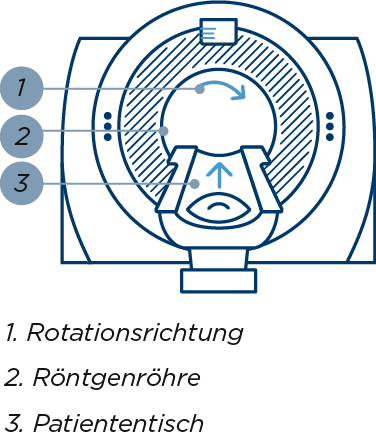
Die Computertomographie (CT) ermöglicht die gezielte Behandlung anatomisch schwer zugänglicher oder tief liegender Muskelgruppen, wie etwa der tiefen Nackenmuskulatur bei komplexen zervikalen Dystonien. Dieses bildgebende Verfahren kann genutzt werden, um die genaue Positionierung der Nadel zu planen.
Der Prozess umfasst folgende Schritte:
- Lokalisation: Erstellung einer CT-Aufnahme zur Identifikation der Zielmuskeln.
- Planung: Festlegung der Einstichstelle und Berechnung der benötigten Einstichtiefe.
- Kontrolle: Durchführung einer Kontrollaufnahme nach Positionierung der Nadel.
- Applikation: Injektion des Wirkstoffs, deren Verteilung im Zielgebiet abschließend verifiziert werden kann.
Medizinische Skalen sind standardisierte Messinstrumente zur objektiven Dokumentation des Schweregrads einer Spastik und der Bewertung von Therapieerfolgen. Sie erfassen, je nach Instrument, sowohl klinische Parameter (z. B. Muskeltonus, bewegungsabhängige Phänomene, Funktion) als auch das subjektive Empfinden und die Alltagsbeeinträchtigung der Patient*innen.
Der Einsatz dieser Skalen ist für die langfristige Behandlungsplanung unerlässlich, da sie Funktionsverbesserungen und Veränderungen im Krankheitsverlauf messbar machen. Anhand dieser Daten können Ärzt*innen und Patient*innen gemeinsam entscheiden, ob die gewählte Therapie optimiert oder angepasst werden muss.
Quellenangaben
- Deutsche Gesellschaft für Neurologie (DGN), Deutsche Gesellschaft für Neurorehabilitation (DGNR). Therapie des spastischen Syndroms. S2k-Leitlinie (AWMF-Registernummer 030/078). Leitlinienreport, 1. Auflage, Stand April 2025. AWMF; 2025
- Siaw-Debrah, F., Nyanzu, M., Apusiyene, G., & Adjei-Osei, E. (2024). Spasticity: A general outlook of pathogenesis and current management. International Journal of Science and Research Archive. https://doi.org/10.30574/ijsra.2024.13.1.1681.
- Dressler, D., Bhidayasiri, R., Bohlega, S., Chaná, P., Chien, H., Chung, T., Colosimo, C., Ebke, M., Fedoroff, K., Frank, B., Kaji, R., Kaňovský, P., Koçer, S., Micheli, F., Orlova, O., Paus, S., Pirtošek, Z., Relja, M., Rosales, R., Sagástegui-Rodríguez, J., Schoenle, P., Shahidi, G., Timerbaeva, S., Walter, U., & Saberi, F. (2018). Defining spasticity: a new approach considering current movement disorders terminology and botulinum toxin therapy. Journal of Neurology, 265, 856-862. https://doi.org/10.1007/s00415-018-8759-1.
- Lindsay, C., Ispoglou, S., Helliwell, B., Hicklin, D., Sturman, S., & Pandyan, A. (2020). Can the early use of botulinum toxin in post stroke spasticity reduce contracture development? A randomised controlled trial. Clinical Rehabilitation, 35, 399 – 409. https://doi.org/10.1177/0269215520963855.
- Bhimani, R., McAlpine, C., & Henly, S. (2012). Understanding spasticity from patients‘ perspectives over time. Journal of advanced nursing, 68 11, 2504-14. https://doi.org/10.1111/j.1365-2648.2012.05949.x.
- Sheean, G. (2002). The pathophysiology of spasticity. European journal of neurology, 9 Suppl 1, 3-9; dicussion 53-61. https://doi.org/10.1046/j.1468-1331.2002.0090s1003.x.
- Stevenson, V. (2010). Rehabilitation in practice: Spasticity management. Clinical Rehabilitation, 24, 293-304. https://doi.org/10.1177/0269215509353254.
- Chou, R., Peterson, K., & Helfand, M. (2004). Comparative efficacy and safety of skeletal muscle relaxants for spasticity and musculoskeletal conditions: a systematic review. Journal of pain and symptom management, 28 2, 140-75. https://doi.org/10.1016/j.jpainsymman.2004.05.002.
- Peck, J., Urits, I., Crane, J., McNally, A., Noor, N., Patel, M., Berger, A., Cornett, E., Kassem, H., Kaye, A., & Viswanath, O. (2020). Oral Muscle Relaxants for the Treatment of Chronic Pain Associated with Cerebral Palsy. Psychopharmacology bulletin, 50 4 Suppl 1, 142-162. https://doi.org/10.64719/pb.4387.
- Van Der Gaag, S., Frankema, S., Van Der Ploeg, E., Baart, S., & Huygen, F. (2024). Evaluating Community-Based Intrathecal Baclofen Therapy: Effectiveness, Safety, and Feasibility. Journal of Clinical Medicine, 13. https://doi.org/10.3390/jcm13071840.
- Kaye, A., Cheon, S., Roque, M., Gibbs, C., Mott, K., Wandler, A., Munir, S., Lin, J., Ahmadzadeh, S., Siddaiah, H., Myers, S., Bembenick, K., & Shekoohi, S. (2025). Efficacy, Indications, and Safety of Intrathecal Baclofen Pump: A Narrative Review. Current Pain and Headache Reports, 29. https://doi.org/10.1007/s11916-024-01310-x.
- Homola A, Tsiganenko A. (2023). Application of physical therapy methods for patients after stroke with spasticity in the early period. USMYJ,136(1):21-9. https://doi.org/10.32345/USMYJ.1(136).2023.21-29
- Cruz, P., Cossins, J., Beeson, D., & Vincent, A. (2020). The Neuromuscular Junction in Health and Disease: Molecular Mechanisms Governing Synaptic Formation and Homeostasis. Frontiers in Molecular Neuroscience, 13. https://doi.org/10.3389/fnmol.2020.610964.
- Ganguly, J., Kulshreshtha, D., Almotiri, M., & Jog, M. (2021). Muscle Tone Physiology and Abnormalities. Toxins, 13. https://doi.org/10.3390/toxins13040282.
- Del Vecchio, A., Negro, F., Holobar, A., Casolo, A., Folland, J., Felici, F., & Farina, D. (2019). You are as fast as your motor neurons: speed of recruitment and maximal discharge of motor neurons determine the maximal rate of force development in humans. The Journal of Physiology, 597. https://doi.org/10.1113/jp277396.
- Cacciatore, T., Anderson, D., & Cohen, R. (2024). Central mechanisms of muscle tone regulation: implications for pain and performance. Frontiers in Neuroscience, 18. https://doi.org/10.3389/fnins.2024.1511783.
- Keles, C., & Ates, F. (2022). Botulinum Toxin Intervention in Cerebral Palsy-Induced Spasticity Management: Projected and Contradictory Effects on Skeletal Muscles. Toxins, 14. https://doi.org/10.3390/toxins14110772.
- Ayoub, N. (2025). Botulinum Toxin Therapy: A Comprehensive Review on Clinical and Pharmacological Insights. Journal of Clinical Medicine, 14. https://doi.org/10.3390/jcm14062021
- Picelli, A., Santamato, A., Chemello, E., Cinone, N., Cisari, C., Gandolfi, M., Ranieri, M., Smania, N., & Baricich, A. (2019). Adjuvant treatments associated with botulinum toxin injection for managing spasticity: An overview of the literature. Annals of physical and rehabilitation medicine. https://doi.org/10.1016/j.rehab.2018.08.004.
- Kadir, S. (2023). Industrial Production and Therapeutic Application of Botulinum Neurotoxin: The Role of C. botulinum Type A. Pharmaceutical nanotechnology. https://doi.org/10.2174/2211738511666230825150259.
- Luvisetto, S. (2021). Botulinum Neurotoxins in Central Nervous System: An Overview from Animal Models to Human Therapy. Toxins, 13. https://doi.org/10.3390/toxins13110751.
- Spiegel, L., Ostrem, J., & Bledsoe, I. (2020). FDA Approvals and Consensus Guidelines for Botulinum Toxins in the Treatment of Dystonia. Toxins, 12. https://doi.org/10.3390/toxins12050332.
- Otero-Luis, I., Martínez-Rodrigo, A., Cavero-Redondo, I., Moreno-Herráiz, N., Martínez-García, I., & Saz-Lara, A. (2024). Effect of Botulinum Toxin Injections in the Treatment of Spasticity of Different Etiologies: An Umbrella Review. Pharmaceuticals, 17. https://doi.org/10.3390/ph17030310.
- Hsu, P., Chang, K., Chiu, Y., Wu, W., & Özçakar, L. (2021). Comparative Effectiveness of Botulinum Toxin Injections and Extracorporeal Shockwave Therapy for Post-Stroke Spasticity: A Systematic Review and Network Meta-Analysis. E Clinical Medicine, 43. https://doi.org/10.1016/j.eclinm.2021.101222.
- Tamayo, F., Rosales, R., Wissel, J., Biering-Sørensen, B., Ellano, J., & Simpson, D. (2025). Botulinum Toxin in Pain-Related Post-Stroke Limb Spasticity: A Meta-Analysis of Early and Late Injections. Toxins, 17. https://doi.org/10.3390/toxins17050258.
- Shulga, O., Klochak, A., Skrypka, M., & Merzhuk, V. (2025). Safety profile and side effects of botulinum toxin in neurological practice. Psychiatry Neurology and Medical Psychology. https://doi.org/10.26565/2312-5675-2025-30-09.
- Dressler, D., Altavista, M., Altenmueller, E., Bhidayasiri, R., Bohlega, S., Chaná, P., Chung, T., Colosimo, C., Fheodoroff, K., Garcia-Ruiz, P., Jeon, B., Jin, L., Kaňovský, P., Milanov, I., Micheli, F., Orlova, O., Pandey, S., Pirtošek, Z., Relja, M., Rosales, R., Sagástegui-Rodríguez, J., Shahidi, G., Timerbaeva, S., Wan, X., Walter, U., & Saberi, F. (2021). Consensus guidelines for botulinum toxin therapy: general algorithms and dosing tables for dystonia and spasticity. Journal of Neural Transmission, 128, 321 – 335. https://doi.org/10.1007/s00702-021-02312-4.
- Jacinto, J., Camões-Barbosa, A., Carda, S., Hoad, D., & Wissel, J. (2022). A practical guide to botulinum neurotoxin treatment of shoulder spasticity 1: Anatomy, physiology, and goal setting. Frontiers in Neurology, 13. https://doi.org/10.3389/fneur.2022.1004629.
- Doan, T., Kuo, M., & Chou, L. (2021). Efficacy and Optimal Dose of Botulinum Toxin A in Post-Stroke Lower Extremity Spasticity: A Systematic Review and Meta-Analysis. Toxins, 13. https://doi.org/10.3390/toxins13060428.
- Walter, U., Mühlenhoff, C., Benecke, R., Dressler, D., Mix, E., Alt, J., Wittstock, M., Dudesek, A., Storch, A., & Kamm, C. (2020). Frequency and risk factors of antibody-induced secondary failure of botulinum neurotoxin therapy. Neurology, 94, e2109 – e2120. https://doi.org/10.1212/wnl.0000000000009444.
- Karp, B., Ly, A., & Alter, K. (2025). Localization Modalities for Botulinum Neurotoxin Injection. Toxicon : official journal of the International Society on Toxinology, 108460. https://doi.org/10.1016/j.toxicon.2025.108460.
- Erro, R., Picillo, M., Pellecchia, M., & Barone, P. (2023). Improving the Efficacy of Botulinum Toxin for Cervical Dystonia: A Scoping Review. Toxins, 15. https://doi.org/10.3390/toxins15060391.
- Shipkov, H., Uchikov, P., Imran, A., Hassan, Z., Grozdev, I., Kraev, K., Kraeva, M., Koleva, N., Bozhkova, M., & Karamitev, S. (2025). Comparing Injection Methods of Botulinum Toxin A for Cervical Dystonia: A Systematic Review. Life, 15. https://doi.org/10.3390/life15060920.
- Popescu, M., Căpeț, C., Beiu, C., & Berteanu, M. (2025). The Elias University Hospital Approach: A Visual Guide to Ultrasound-Guided Botulinum Toxin Injection in Spasticity: Part I—Distal Upper Limb Muscles. Toxins, 17. https://doi.org/10.3390/toxins17030107.
- Chen, C., Chen, C., Chen, H., Wu, C., Lin, K., Hsieh, Y., & Shen, I. (2020). Responsiveness and minimal clinically important difference of Modified Ashworth Scale in patients with stroke. European journal of physical and rehabilitation medicine. https://doi.org/10.23736/s1973-9087.19.05545-x.